

Leaning tree emergency tucker stone mountain: When to Act Before Trees Fall
A leaning tree in your Tucker or Stone Mountain yard isn’t just a cosmetic concern—it’s a disaster waiting to happen. Every day that passes increases the likelihood of catastrophic failure that could destroy your home, injure your family, or create tens of thousands of dollars in property damage you might have prevented with timely action.
Francisco’s Trees 24/7 responds to leaning tree emergencies throughout Tucker, Stone Mountain, and surrounding DeKalb County communities where delayed action has turned manageable situations into devastating disasters. We’ve removed hundreds of dangerously leaning trees before they fell, and we’ve cleaned up the aftermath when homeowners waited too long.
This guide explains why leaning trees in Tucker and Stone Mountain are particularly dangerous, how to recognize when your leaning tree has become an emergency, and why immediate professional intervention is the only safe response to trees showing signs of imminent failure.
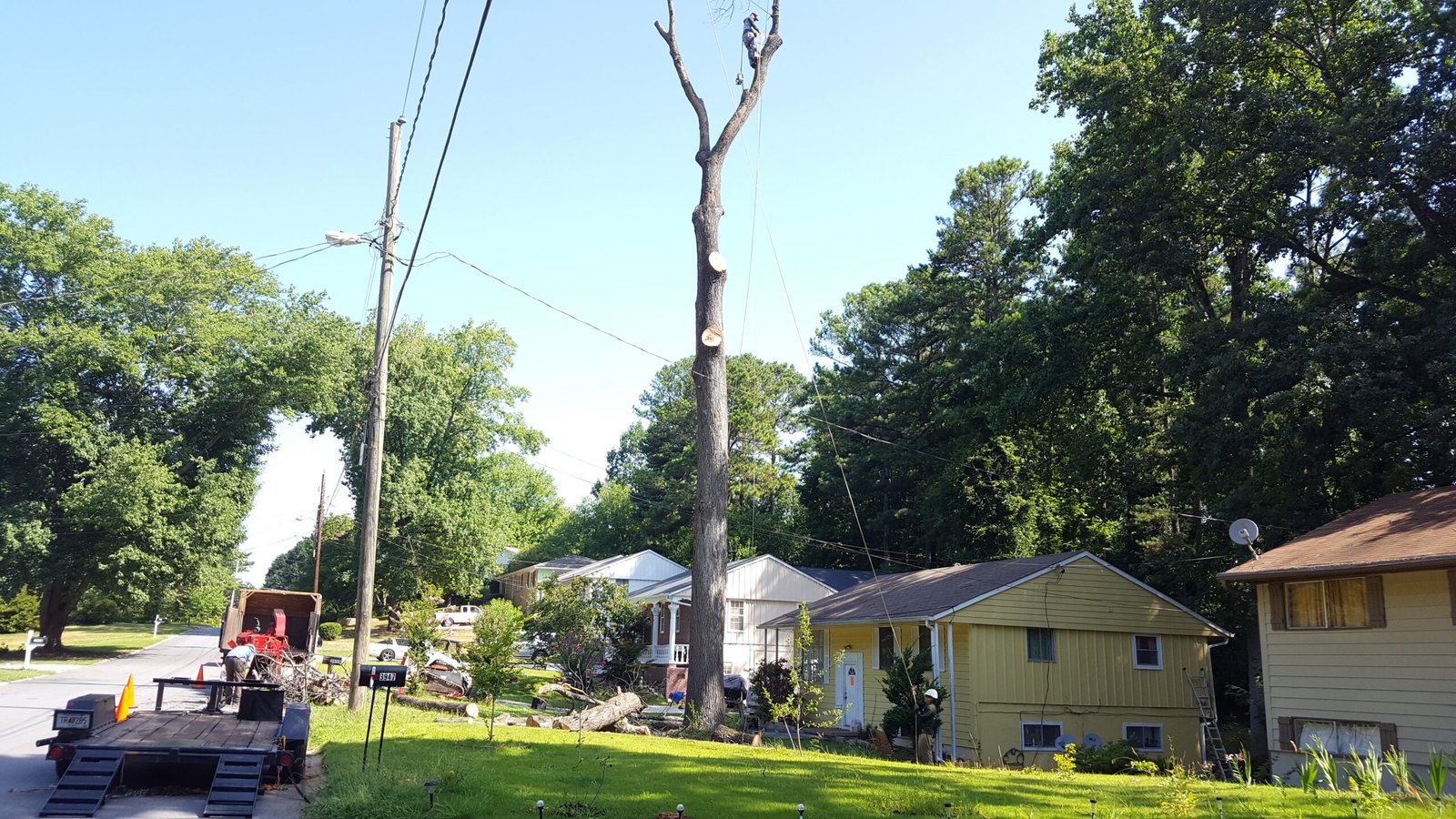
Why Tucker & Stone Mountain Face Unique Leaning Tree Risks
The communities of Tucker and Stone Mountain present specific conditions that create elevated risks from leaning trees:
Topographical Challenges
Stone Mountain’s elevated terrain creates unique soil and drainage patterns that affect tree stability. Properties on slopes face different risks than flat terrain, with trees often leaning downhill as root systems on the uphill side deteriorate faster than downhill roots.
Throughout the Stone Mountain area, from the mountain’s base through surrounding neighborhoods, slope-related tree leans are common. Gravity constantly pulls on trees growing at angles, and roots must work continuously to resist these forces.
Tucker’s varied topography includes both flat areas and rolling terrain where drainage patterns concentrate water in low spots. Trees in poorly drained areas develop compromised root systems that fail during wet periods, creating sudden dangerous leans.
Soil Conditions in Eastern DeKalb County
Georgia red clay throughout Tucker and Stone Mountain becomes concrete-hard when dry and slippery when saturated. This extreme variation in soil conditions creates unique challenges for tree stability.
During extended dry periods, clay soils shrink and crack, creating gaps around root systems. When heavy rains arrive, water rushing into these cracks saturates soil rapidly, turning firm ground into slippery mud that provides little root support.
Shallow soil over granite bedrock in areas near Stone Mountain limits root depth and spread. Trees with restricted root systems have less structural support and are more vulnerable to developing dangerous leans.
Compacted soils in developed areas prevent deep root penetration. Trees forced to grow shallow root systems in compacted clay are particularly prone to leaning and failure during storms or wet weather.
Weather Patterns Affecting the Area
Tucker and Stone Mountain experience Georgia’s severe weather with particular intensity:
Thunderstorm frequency from spring through early fall means trees face repeated high-wind stress events. A tree that survives one storm with minor lean may fail during subsequent weather events.
Tornadic activity has affected DeKalb County multiple times, with Tucker and Stone Mountain experiencing damage from both actual tornadoes and straight-line winds that create tornado-like destruction.
Flash flooding during heavy rains saturates soils rapidly throughout both communities. Trees that appeared stable in dry conditions can lean dramatically or fail completely when soil becomes saturated during intense rainfall events.
Winter ice storms occasionally load tree branches with heavy ice, creating immense leverage forces on trunks. Leaning trees loaded with ice are particularly prone to catastrophic failure.
Mature Tree Population and Age-Related Risks
Established neighborhoods in Tucker feature trees planted 40-60 years ago when subdivisions first developed. These aging trees face increasing structural challenges as root systems deteriorate and decay progresses.
Stone Mountain’s older homes often feature trees that predate development, with some specimens exceeding 80-100 years of age. While these magnificent trees provide character, their advanced age means they’re approaching the end of their structural lifespan.
Trees in their mature and over-mature phases show:
- Root system decline and decay
- Trunk and branch cavities from old wounds
- Reduced vigor and stress resistance
- Increased susceptibility to storm damage
The Anatomy of Tree Failure - How Leans Progress to Disaster
Understanding how tree failures develop helps homeowners recognize emergencies before catastrophe occurs:
Initial Root System Compromise
Tree leans begin with root system problems:
Disease and decay attack roots underground where problems aren’t visible until trees begin leaning. Fungal pathogens can destroy major structural roots while trees appear healthy above ground.
Construction damage from utility trenching, driveway installation, or building work severs roots that cannot regenerate. Trees may appear unaffected for months or years before damage manifests as visible lean.
Soil compaction from vehicles, foot traffic, or construction equipment destroys soil structure necessary for root function. Compacted clay in Tucker and Stone Mountain is particularly problematic for root health.
Drainage changes from development, landscaping, or natural erosion alter moisture patterns around root systems. Roots adapted to previous drainage may decline when conditions change.
H3: Progressive Failure Stages
Once root compromise begins, failure progresses through predictable stages:
Stage 1 – Hidden damage: Root problems exist but trees show no visible lean. This stage can last months or years depending on damage extent and tree species.
Stage 2 – Minor visible lean: Trees develop slight angles (5-10 degrees) that may be barely noticeable. Casual observers might not recognize the lean, but professional assessment would identify problems.
Stage 3 – Obvious lean: Trees show clear angles (10-20 degrees) visible to anyone. At this stage, soil heaving or exposed roots often become apparent, and failure risk is significant.
Stage 4 – Severe lean: Trees lean dramatically (over 20 degrees) with visible root system failure, soil cracks, and obvious instability. Failure is imminent—the only question is timing.
Stage 5 – Catastrophic failure: Trees fall completely, typically during storms or heavy rain when final root connections tear free or weakened trunks break.
Acceleration Factors
Several factors accelerate progression from early stages to catastrophic failure:
Weather events push trees with compromised stability past structural limits.
Continued root decay progressively reduces support, making each stage shorter than the previous one.
Increased leverage as lean angles increase puts more stress on remaining roots, accelerating their failure.
Soil disruption around failing root balls allows more movement, creating feedback loops where movement causes more damage which allows more movement.
Point of No Return
Trees reach a point where failure becomes inevitable:
Critical lean angles vary by species and condition, but generally trees leaning over 15-20 degrees from vertical cannot recover even if underlying problems were addressed.
Root loss beyond recovery occurs when too many structural roots have failed. Even if remaining roots were healthy, insufficient support exists to maintain stability.
Progressive wood failure in trunks creates situations where even if root systems were intact, trunk damage would cause failure under storm loads.
Once trees pass the point of no return, removal becomes the only safe option. Attempting to stabilize or save these trees creates more danger than benefit.
Critical Warning Signs Every Tucker & Stone Mountain Homeowner Must Know
Recognizing these signs can save your home and possibly your life:
Immediate Emergency Indicators
Call for same-day emergency assessment if you observe:
Soil lifting or mounding around the trunk base on the side opposite the lean. This visible root ball movement indicates active failure—the tree is literally pulling up from the ground.
In Tucker and Stone Mountain’s clay soils, soil heaving creates distinctive cracked, lifted areas that are impossible to miss once you know what to look for.
Fresh trunk cracks particularly at ground level or at points of greatest stress. These indicate the trunk is literally tearing itself apart—failure is imminent.
Exposed roots that were buried yesterday but are visible today. Roots should remain underground—seeing them exposed means the tree is actively moving and will fail soon.
Leaning that increased overnight or during storms. Any tree showing progressive lean over hours or days is in active failure and requires immediate emergency response.
Trees that move when you push against the trunk. Stable trees should not rock when pushed—movement indicates root failure has progressed to the point where the tree is barely attached to the ground.
Urgent Warning Signs
Schedule immediate professional assessment (within 24-48 hours) for:
Moderate visible lean that developed after recent storms. Trees showing 10-20 degree leans that weren’t present before weather events need urgent evaluation.
Dying branches combined with any degree of lean. The combination of structural instability and declining health indicates multiple problems converging to create high failure risk.
Soil cracks radiating from the trunk in Tucker’s clay or Stone Mountain’s thin soils over bedrock. These cracks indicate root movement and impending failure.
Fungal growth (mushrooms or shelf fungi) on trunks of leaning trees. These fruiting bodies indicate internal decay that severely compromises strength when combined with structural instability.
Recent construction activity near previously straight trees that now show any lean. Construction damage may have compromised roots, creating situations where trees will progressively lean until failure.
Trees That Require Monitoring
Some situations don’t demand immediate removal but need regular professional reassessment:
Minor leans (under 5 degrees) in otherwise healthy trees may be stable if the lean has been consistent for years. However, professional assessment should confirm stability and establish monitoring schedules.
Trees leaning away from structures into wooded areas or open yards pose lower immediate property risk but still require evaluation to determine long-term stability.
Naturally leaning trees that grew at angles from youth and show compensating root development may be safe, but professional assessment should confirm that growth patterns support the lean adequately.
Long-Term Perspective
Tree disputes test neighbor relationships, but maintaining perspective helps:
Property Values and Trees
Mature trees enhance property values throughout Metro Atlanta, even when they create occasional conflicts:
Established landscapes in Buckhead, Druid Hills, and older neighborhoods contribute substantially to property appeal and pricing.
Tree-lined streets remain among the most desirable features in communities throughout Sandy Springs, Brookhaven, and established areas.
Mature canopy provides environmental benefits – shade, air quality, storm water management – that serve entire communities.
Preserving trees while addressing legitimate concerns balances individual property rights with community benefits that enhance all properties.
Neighborhood Harmony
Communities where neighbors resolve disputes diplomatically become more desirable places to live:
Reputation for reasonableness attracts buyers who value community cooperation over adversarial relationships.
Established dispute resolution patterns help future neighbors address issues effectively without creating precedents for unreasonable demands.
Professional approaches to legitimate conflicts demonstrate community maturity that enhances property values and living experience.
Real Emergency Responses in Tucker & Stone Mountain
Case studies illustrating importance of prompt action:
The Tucker Pine Emergency
A 65-foot loblolly pine in Tucker developed a visible lean after spring thunderstorms. The homeowner called for assessment the same day, expressing concern about the tree’s proximity to their home. Our inspection revealed extensive root plate failure—the entire root system was pulling up from saturated clay soil.
We recommended immediate removal, which was completed that afternoon. During removal, we confirmed that another heavy rain or wind event would have caused complete failure. The tree’s root system had less than 40% of its original anchorage remaining.
Result: Emergency prevented through same-day response. Home protected, family safe.
The Stone Mountain Tragedy
A mature oak in Stone Mountain showed minor lean for several weeks. The homeowner planned to “get it looked at” but didn’t treat it as urgent. During a summer thunderstorm, the tree failed catastrophically, crashing through the roof into a child’s bedroom. Fortunately, the child was in another part of the house, but injuries were narrowly avoided.
Cost: Over $40,000 in damages, family displaced for six weeks, traumatic experience that could have been prevented.
Lesson: Even “minor” leans in mature trees require immediate assessment, not delayed action.
The Neighbor Conflict Resolution
Two Tucker properties shared a boundary oak that developed severe lean toward one home after construction on the other property damaged roots. Initially, property owners disagreed about responsibility. After our assessment documented construction damage as the cause, property owners agreed to split removal costs 70/30 based on relative responsibility.
Result: Fair resolution, both properties protected, relationship preserved through professional mediation.
Leaning trees in Tucker and Stone Mountain demand immediate professional attention. The risks are too high, the consequences too severe, and the progression too unpredictable to wait or hope trees will stabilize on their own. They won’t.
If you have a leaning tree on your property or are concerned about a leaning tree threatening your home, contact Francisco’s Trees 24/7 immediately. Don’t wait for the next storm, don’t wait until it’s more convenient, don’t wait to see if the lean gets worse—by then it may be too late.
Our certified arborists serve Tucker, Stone Mountain, and all of DeKalb County with emergency assessment and removal services available around the clock. We understand the urgency these situations demand, and we’re committed to protecting your property and your family through rapid, professional response.
Call now for immediate assessment of leaning trees in Tucker and Stone Mountain. Available 24/7 for emergency tree removal throughout DeKalb County. Don’t wait for disaster—protect your home today.
Several specific signs indicate a leaning tree in Tucker or Stone Mountain has crossed from a monitoring situation into a same-day emergency requiring immediate professional response. Soil lifting or mounding on the opposite side of the lean — visible cracking or heaving of the ground around the trunk base — means the root ball is actively pulling free from the ground and failure can occur at any moment. A lean that has visibly increased since yesterday or since the last rain event indicates active progressive failure, not a stable historical lean. The trunk moves when you push against it — any detectable movement in the root zone when moderate pressure is applied means root anchorage has failed to a critical degree. Fresh vertical cracks in the trunk at or near ground level indicate the wood itself is tearing under the structural load of the lean. Exposed roots that were underground yesterday confirm the tree is actively uprooting. If you observe any single one of these signs on a Tucker or Stone Mountain property, call Francisco’s Trees 24/7 at (678) 940-6503 immediately — do not wait for a storm to make the decision for you.
Tucker and Stone Mountain present a specific combination of soil, topographic, and weather conditions that make leaning trees in these communities particularly high-risk compared to many other metro Atlanta areas. Georgia red clay soil throughout eastern DeKalb County undergoes extreme condition swings — during drought it contracts and cracks, creating voids around root systems; when heavy rain arrives, those same cracks allow rapid water infiltration that turns firm soil into near-liquid mud with almost no root anchorage capacity. This means a tree that survived dry-weather wind events can fail suddenly when the soil saturates during a single heavy rain. Stone Mountain’s elevated terrain and slope conditions create additional gravitational load on trees growing at angles, with gravity constantly working to accelerate any existing lean. Shallow granite bedrock in areas near Stone Mountain severely limits root depth — trees that cannot anchor deep must rely on lateral spread, and when lateral roots in clay soil lose their grip during saturation, there is no deeper anchor to compensate. Tucker’s established neighborhoods feature trees 40–60 years old entering the phase where internal root decay progresses rapidly without visible external symptoms. This combination — expansive clay soils, topographic challenges, restricted root depth near bedrock, and an aging tree population — creates leaning tree risk conditions that our certified arborists encounter more frequently in Tucker and Stone Mountain than in most other DeKalb communities.
This distinction is one of the most important assessments our ISA-certified arborists make when evaluating leaning trees in Tucker and Stone Mountain, and it directly determines the urgency of the response. A naturally leaning tree — one that grew at an angle from its earliest years — has had decades to develop compensating root architecture on the tension side of the lean, with denser, stronger root development pulling against the direction of lean. The trunk wood also develops reaction wood internally that provides additional structural resistance along the lean axis. These trees can be remarkably stable despite their visible angle and may have been safe in their leaned position for decades. By contrast, a recently developed lean — a tree that was previously vertical and has shifted to an angle — indicates that something has changed in the tree’s structural support. The root system was designed to support a vertical tree, not a leaning one, meaning the remaining root connections are now under stress loads they were never engineered to handle. Recent leans in Tucker and Stone Mountain are most commonly triggered by storm root disturbance, soil saturation uprooting, construction damage to roots, or progressive internal root decay reaching a tipping point. Any tree showing a lean that wasn’t present or was significantly less pronounced before a recent storm, rain event, or construction activity in the area should be treated as an active emergency requiring professional assessment within 24 hours, not a monitoring situation.
In a limited number of situations, yes — but the conditions that allow for stabilization rather than removal are specific and must be confirmed by ISA-certified arborist assessment, not assumed. Trees that may be candidates for stabilization rather than removal are those with leans of less than 10 degrees that are otherwise structurally healthy with no trunk decay, no root plate movement, no soil heaving, and a lean that has been stable (not progressive) over time. For these trees, cabling and bracing systems installed by certified arborists can provide supplemental structural support for co-dominant stems or lateral lean, and root zone treatments can improve the health of the remaining root system. However, the majority of leaning trees our team assesses in Tucker and Stone Mountain that triggered an emergency call do not meet these criteria — trees that have developed significant lean in response to a storm, saturation event, or progressive root decay are almost never stabilization candidates because the root system damage that caused the lean cannot be reversed, and the lean angle itself puts increasing stress on remaining roots that accelerates further failure. The single most dangerous outcome in leaning tree situations is a homeowner hoping for stabilization when removal is actually the only safe answer — because that hope leads to delayed action that increases the probability of catastrophic failure during the next weather event. Francisco’s Trees 24/7 provides honest assessments that tell you what the tree actually needs, not what you might hope to hear — call (678) 940-6503 for evaluation throughout Tucker, Stone Mountain, and all of DeKalb County.
Eastern DeKalb County’s red clay soil behavior during rain events is one of the most significant and underappreciated tree hazard factors in Tucker and Stone Mountain neighborhoods. Understanding this mechanism helps homeowners recognize why a tree that has stood safely through years of dry-weather windstorms can fail suddenly and without warning during a heavy rain event with relatively moderate wind. Clay soil has a unique property called thixotropy — it transitions from a semi-solid state to a near-liquid state when mechanically disturbed or saturated, losing structural strength dramatically in the process. As rain saturates Tucker’s clay soils, the firm ground that normally grips tree roots transforms into a medium with greatly reduced shear strength — meaning the soil can no longer resist the lateral force of the tree moving horizontally. For trees that are already leaning, this is especially critical: the soil on the tension side of the root system — the side resisting the lean — loses its grip precisely when wind load is highest, creating a simultaneous failure of both the soil anchorage and the structural resistance. This is why the highest-risk period for leaning trees in Tucker and Stone Mountain is not during extended drought (when clay is hard but cracked) or during light rain (insufficient saturation), but specifically during the 12–36 hour window when heavy rainfall has fully saturated the clay soil and any wind arrives to apply lateral load. If you have an identified leaning tree on your Tucker or Stone Mountain property and a significant rain event is forecast, call Francisco’s Trees 24/7 at (678) 940-6503 before the storm — proactive removal in safe conditions is always better than emergency response after failure.
Discovering a severely leaning tree — particularly one that was not leaning significantly before — requires immediate action following a specific safety-first sequence. First and most critical: establish a safety perimeter. Keep all family members, pets, and visitors away from the area beneath and around the tree at a minimum distance equal to the tree’s full height in the direction of the lean. In Tucker and Stone Mountain neighborhoods where a leaning pine or oak may be 60–80 feet tall, this perimeter may extend significantly into your yard and potentially toward a neighbor’s property — communicate this to neighbors if their property falls within the fall zone. Do not go under or near the tree to assess it yourself — a tree in active failure can fall in seconds without any additional trigger. Move vehicles out from under or near the tree immediately if it is safe to do so from a route that doesn’t pass through the fall zone. Photograph the lean from a safe distance including the base of the trunk and any visible soil movement — this documents the condition for both emergency response purposes and insurance claims. Call Francisco’s Trees 24/7 immediately at (678) 940-6503 — describe the lean direction, the approximate angle, any visible soil lifting, and the proximity to structures. Our certified arborists respond to Tucker and Stone Mountain emergency calls around the clock and can advise on immediate safety measures while our crew is en route. Do not attempt any work on the tree yourself — leaning trees under structural stress behave unpredictably when disturbed.
Slope-related tree leans in the Stone Mountain area present a specific failure pattern that differs from flat-terrain Tucker neighborhood leans in important ways that affect both assessment and urgency. On sloped Stone Mountain terrain, trees frequently develop downhill leans as gravity and seasonal soil movement gradually pull them in the downhill direction over years. The uphill side root system typically shows earlier deterioration because drainage patterns concentrate root zone saturation on the uphill side during rain events, while the downhill roots are more consistently exposed to drier, more structurally supportive soil conditions. This creates an asymmetric root system where the already-stressed direction — uphill — is also the side where soil saturation hits hardest during storms. Slope-related leans also involve soil movement — in Stone Mountain’s terrain, the entire soil layer above granite bedrock can shift subtly during heavy rain events in a process called soil creep, which gradually tilts trees that are rooted in that mobile layer. This is a fundamentally different mechanism from root decay leans on Tucker’s flat terrain, and it can be deceptive because the tree’s root system may be relatively healthy while the soil itself is moving. Additionally, shallow bedrock in Stone Mountain-area properties limits how deep roots can anchor, creating trees that are entirely dependent on lateral root spread in a relatively thin soil layer — when that layer saturates, the anchorage is dramatically reduced regardless of root health. Our certified arborists assess slope and bedrock factors as part of every Tucker and Stone Mountain leaning tree evaluation — call (678) 940-6503 for a professional assessment tailored to your specific terrain conditions.
Yes — absolutely and without exception. Leaning tree emergencies in Tucker and Stone Mountain do not follow business hours, and neither does our emergency response. When you call (678) 940-6503 at 11 PM on a Saturday because a storm has shifted a large pine toward your Tucker home, you reach a live member of our team directly — not voicemail, not an answering service, not a dispatcher who will relay a message in the morning. For active structural emergencies — soil lifting, visible root plate movement, a lean that has changed during an ongoing storm — we dispatch immediately and typically reach Tucker and Stone Mountain properties within 1–2 hours of your call regardless of time of day. For situations where the tree is stable enough that there is no imminent collapse risk but still requires urgent professional assessment before the next weather event, we schedule priority same-day or next-morning evaluation. Our emergency response capability for Tucker, Stone Mountain, and all of DeKalb County is genuine — we maintain crews on standby specifically because the highest-demand periods for tree emergencies are evenings and weekends following afternoon and overnight storms, which is exactly when Georgia’s weather creates these situations. Save (678) 940-6503 in your phone now before you need it — a leaning tree emergency is not the moment to search for a contractor. We also strongly encourage Tucker and Stone Mountain homeowners to call for a free pre-storm hazard assessment before storm season, when we can evaluate leaning trees in safe conditions and address them proactively rather than reactively.


