

storm season tree preparation Fulton County GA: How to Protect Your Property from Tree Damage in 2026
Every year, Georgia’s storm season produces billions of dollars in property damage — and trees are responsible for a significant portion of that destruction. In Fulton County, where dense urban canopies shade established neighborhoods from Buckhead to Alpharetta, the combination of aging trees, clay soils, and Georgia’s increasingly severe storm patterns creates elevated risk for homeowners who haven’t taken proactive steps to prepare their properties.
Francisco’s Trees 24/7 has served Fulton County through multiple severe storm seasons, and the pattern is consistent: properties with professionally maintained trees suffer dramatically less damage than those where trees were left unaddressed. This comprehensive storm preparation guide walks you through everything Fulton County homeowners need to know to protect their properties in 2026.
storm season tree preparation Fulton County GA
Understanding Fulton County's Storm Risk Profile in 2026
Georgia’s Changing Storm Patterns
Climate data from recent years shows a clear trend in Fulton County and the broader Atlanta metro area: storms are becoming more intense even if their frequency remains similar. Fulton County now experiences regular straight-line wind events exceeding 60-70 mph, larger hail events, more frequent tornado touchdowns in suburban areas, and rainfall events that saturate soils faster than drainage systems can handle.
For trees, it’s not just wind speed that matters — it’s the combination of saturated soils (which dramatically reduce root anchorage) and high winds occurring simultaneously. This combination, which occurs with almost every significant Georgia thunderstorm, is what takes down trees that survived previous storms at similar wind speeds.
Fulton County’s Infrastructure Age Factor
Stormwater and utility infrastructure throughout established Fulton County neighborhoods — installed decades ago — creates underground conditions that compromise tree health. Root intrusion into aging clay sewer lines leads to root pruning during line repairs. Improperly installed underground utilities damaged roots during original installation. Aging drainage systems create areas of chronic soil saturation that accelerate root decay.
Trees growing over compromised underground infrastructure are at dramatically elevated risk during storm events because their root systems have been silently damaged for years without visible above-ground symptoms.
The 2026 Pre-Storm Season Tree Inspection Checklist for Fulton County Homeowners
Professional arborist assessment provides the most accurate risk evaluation, but this systematic checklist helps Fulton County homeowners identify the trees most urgently requiring professional attention:
High-Priority Inspection Targets
Trees within fall distance of structures: Any tree whose height equals or exceeds its distance from your home, detached garage, fence, or neighbor’s property should be evaluated before storm season.
Trees with visible deadwood: Dead branches — identifiable by missing leaves, brittle bark, and cracking wood — fall before living branches in storms. Large dead limbs overhanging your home or outdoor living areas require removal before storm season begins.
Trees with co-dominant stems: V-shaped forks where two main stems grow at equal size create weak unions that split catastrophically under wind load. Trees with included bark in these forks (bark tissue trapped between stems) are particularly vulnerable.
Recently transplanted trees: Trees transplanted within the last 3-5 years haven’t fully established root systems and are dramatically more vulnerable to wind throw. These trees may need staking assessment before storm season.
Trees with previous storm damage: Trees that sustained damage in previous storms — even if they were left standing — have compromised structural integrity that makes them more likely to fail in subsequent storms.
What to Look for During Your Inspection
Walk around each tree on your Fulton County property and document:
- Cavities in the trunk or major limbs — any hollow area requires professional evaluation
- Cracks running vertically or diagonally through the trunk — these indicate failure planes
- Mushrooms or bracket fungi on the trunk or at the base — indicates active wood decay
- Sudden lean development since your last inspection
- Crown imbalance — canopy much heavier on one side than the other
- Root damage from construction, landscaping, or utility work in the past 3 years
- Trunk wounds from previous storm damage, vehicle impacts, or lawn equipment
Storm Preparation Actions That Protect Fulton County Properties
Professional Canopy Risk Reduction
The most effective storm preparation action for Fulton County homeowners is professional canopy management. This doesn’t mean removing all trees — it means strategic work that reduces wind resistance while maintaining tree health and structural integrity:
- Crown cleaning: Removing dead, dying, and crossing branches eliminates the projectiles that cause most storm damage and reduces wind resistance
- Structural pruning: Addressing co-dominant stems, included bark unions, and excessive end weight in large limbs
- Crown reduction: Selectively reducing the overall canopy on high-risk trees to decrease wind load
- Hazard tree removal: Identifying trees that present unacceptable risk and removing them before storm season
Why Topping is Never the Answer
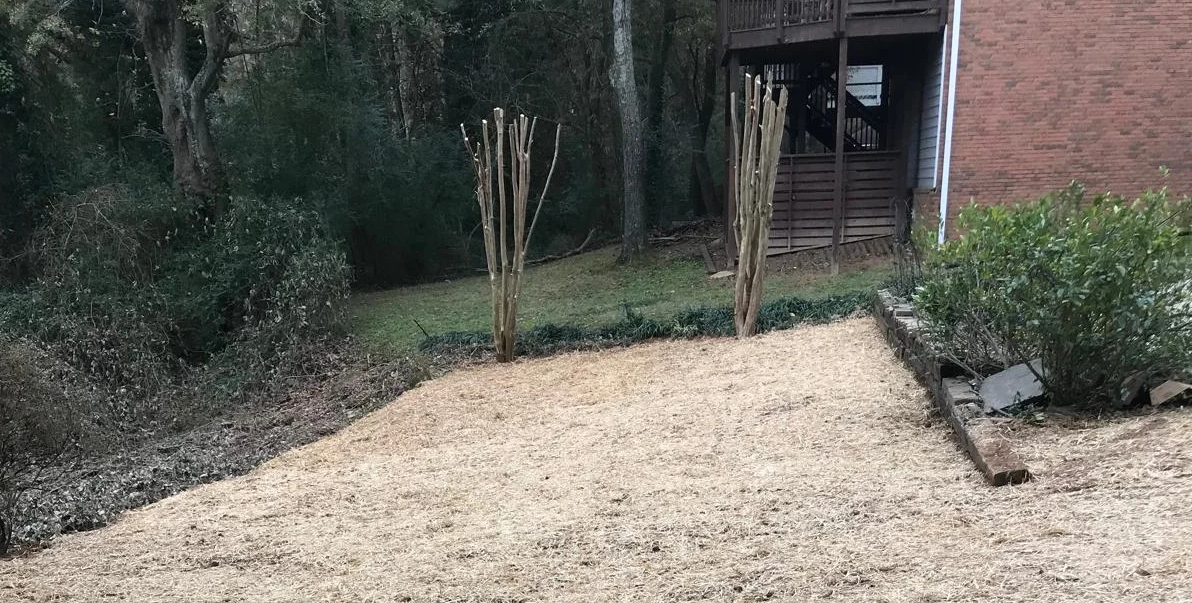
Many Fulton County homeowners have encountered contractors who suggest ‘topping’ trees as a storm preparation measure. Tree topping — cutting all branches back to stubs — is universally condemned by professional arborists for one critical reason: it makes trees more dangerous, not less.
Topped trees respond to the extreme stress of topping by producing dozens of fast-growing, weakly attached shoots called water sprouts. These sprouts grow rapidly and create a dense canopy that catches more wind, but they attach to the stub with weak wood that fails catastrophically in the first significant storm. If you encounter a contractor recommending topping, that is a signal to find a different contractor.
Cabling and Bracing for Fulton County’s Valuable Trees
For trees with structural defects that make them storm-vulnerable but which are significant landscape assets — large oaks with sentimental value, specimen trees that define a property’s character, trees protecting homes from western afternoon sun — professional cabling and bracing provides structural support that extends the tree’s useful life and reduces storm risk.
Modern dynamic cabling systems use high-strength hardware installed in the upper crown to limit the range of movement in defective forks without completely restricting natural flex. When correctly installed by certified arborists familiar with ISA standards, cabling extends the life of valuable trees while reducing their storm risk profile.
After the Storm: Emergency Response for Fulton County Properties
Even well-prepared properties experience storm damage. Knowing how to respond correctly in the immediate aftermath of a severe storm protects you, your family, and your property:
Immediate Safety Assessment
Before approaching any fallen or damaged trees on your Fulton County property:
- Check for downed power lines — assume all downed lines are energized and maintain at least 30 feet of distance
- Do not approach trees that have partially fallen and are resting against structures — these situations are unstable and can shift without warning
- Do not attempt to walk under trees that are leaning or partially hanging — a secondary failure could be imminent
- Contact your utility company for downed line situations before calling tree service
Documenting Storm Damage for Insurance
Before any cleanup work begins on your Fulton County property, document all damage thoroughly:
- Photograph every affected tree from multiple angles
- Photograph all property damage caused by tree failures
- Note the approximate time damage occurred relative to storm passage
- Document the full extent of debris on your property
This documentation is essential for insurance claims and should be completed before any debris removal.
Fulton County Service Areas: Emergency Tree Response Throughout the County
Francisco’s Trees 24/7 provides 24-hour emergency storm response throughout Fulton County, Georgia. Our emergency response covers all communities within the county, including Atlanta, Sandy Springs, Alpharetta, Roswell, Johns Creek, Milton, Hapeville, East Point, College Park, Union City, and all unincorporated Fulton County areas.
Emergency response is available around the clock because storms don’t wait for business hours. If you’re facing storm damage on your Fulton County property — a fallen tree blocking your driveway, a tree resting on your roof, or a hazardous hanging limb threatening your family — contact us immediately for emergency assessment and response.
⚠️ 24/7 Emergency Storm Response — Fulton County, GA — Call (678) 940-6503 | franciscotrees911.com
Timing is the most critical and most commonly missed element of storm season tree preparation for Fulton County properties. The professional standard is to complete all significant tree work — hazard removal, structural pruning, crown thinning, and cabling installation — by late February to mid-March at the absolute latest, before Georgia’s peak tornado and severe thunderstorm season begins. This timeline matters for two reasons. First, scheduling: reputable certified arborists throughout Fulton County fill their pre-storm season calendars quickly, meaning homeowners who wait until April when the first severe storm warnings appear will find fully booked schedules and may not receive service until after significant weather has already arrived. Second, tree biology: pruning cuts need time to begin the wound closure process before trees face storm stress — fresh large cuts made days before a major storm have not yet begun sealing, potentially creating structural vulnerabilities rather than reducing them. The practical recommendation for Fulton County homeowners is to schedule professional tree assessments in January or February, complete identified priority work through February and March, and have any remaining lower-priority work completed by early April. Francisco’s Trees 24/7 provides free storm preparation assessments throughout all Fulton County communities — Atlanta, Sandy Springs, Alpharetta, Roswell, Johns Creek, Milton, and surrounding areas — call (678) 940-6503 in January or February to secure your pre-storm season appointment before schedules fill.
Not all tree work is equally urgent for storm preparation — certain specific conditions represent disproportionate risk and should be addressed as the highest priorities before storm season arrives in Fulton County. Dead or dying trees within fall distance of structures are the single highest priority: a dead tree has zero structural resistance to storm wind and will fail in conditions that a healthy tree handles without difficulty — these are not monitoring situations but active removal priorities. Large dead limbs in the canopy — often called widow makers — are the most common cause of storm-related property damage in Fulton County because they fail before living wood under the same wind conditions and can launch significant distances when released from the canopy. Co-dominant stems with included bark — V-shaped forks where two trunks of roughly equal size grow together with bark tissue trapped between them — are structurally pre-fractured and commonly split apart in winds that healthy single-leader trees would survive; these are especially prevalent in water oaks, red maples, and Bradford pears throughout Fulton County. Trees leaning toward structures that developed any change in angle since the last inspection have active root system failure that storm saturation will likely complete. Recently damaged trees from previous storms that were left standing with unrepaired structural wounds have compromised integrity that makes them significantly more likely to fail in subsequent events. Trees over aging underground infrastructure — common throughout established Fulton County neighborhoods — that may have experienced silent root damage from utility repairs deserve priority professional evaluation before storm season. Call Francisco’s Trees 24/7 at (678) 940-6503 for a comprehensive storm preparation assessment identifying all priority conditions on your Fulton County property.
Tree topping — the practice of cutting all branches back to stubs regardless of branch structure or tree biology — is consistently and universally condemned by ISA-certified arborists as one of the most harmful practices that can be performed on a tree, and it is especially dangerous as a storm preparation measure despite being marketed that way by unlicensed contractors throughout the Atlanta metro area. The fundamental problem is that topped trees become dramatically more dangerous in storms, not less. When a tree is topped, the extreme stress of losing most of its canopy triggers a survival response — the tree produces dozens of fast-growing shoots called water sprouts directly from the remaining stubs. These sprouts grow at rates of 3–6 feet per year in Georgia’s climate and quickly restore canopy density, but they attach to the parent stub with weak, poorly integrated wood that has none of the structural strength of the natural branch attachments that were removed. Within 2–3 years, a topped Fulton County tree has regrown a dense canopy that catches as much or more wind as before, supported entirely by weakly attached shoots that fail catastrophically under the same storm conditions the original branches would have survived. Topped trees also suffer permanent wound damage — the large stubs cannot close properly, creating entry points for decay fungi that hollow the trunk over subsequent years. The appropriate alternative to topping for storm risk reduction in Fulton County is professional crown reduction performed by ISA-certified arborists — a technique that selectively reduces the overall canopy size by cutting back to lateral branches large enough to assume the terminal role, maintaining natural branch architecture and wound closure capacity while genuinely reducing wind load. If any contractor recommends topping your Fulton County trees, that recommendation alone is sufficient reason to seek a second opinion from a certified arborist.
This is one of the most underappreciated storm risk factors on established Fulton County properties, particularly in neighborhoods throughout Sandy Springs, Buckhead, Roswell, and other communities where infrastructure dates from the 1960s through 1980s. The connection between underground infrastructure and tree storm vulnerability operates through a specific mechanism: when aging sewer lines, water mains, or utility conduits require repair or replacement — which happens with increasing frequency as infrastructure ages — the excavation and repair work cuts through root systems of nearby trees. Individual root cuts from a single utility repair may not produce visible above-ground symptoms and may not significantly compromise a tree’s stability in isolation. However, across decades of repeated utility work throughout a neighborhood, individual trees may have experienced multiple root-cutting events from sidewalk replacement, sewer line repair, gas line installation, cable and fiber upgrades, and drainage improvements — each reducing the effective root system by a percentage while the tree above ground continues growing larger and heavier. The cumulative result is a tree that appears completely healthy from above but is structurally supported by a root system significantly smaller than its canopy requires for storm resistance. Georgia Power, Atlanta Gas Light, and municipal utility departments are not required to assess tree stability when performing necessary infrastructure work, meaning this damage accumulates without any notification or documentation for the property owner. For Fulton County properties where significant utility work has occurred within the past 5 years, or where multiple separate utility projects have taken place over the property’s history, a professional root zone assessment before storm season can identify trees whose root systems have been silently compromised. Call Francisco’s Trees 24/7 at (678) 940-6503 to schedule a pre-storm assessment that includes root zone evaluation throughout your Fulton County property.
Crown thinning is one of the most effective proactive storm preparation techniques available for Fulton County trees and one of the most frequently misunderstood by homeowners. It is fundamentally different from topping, crown reduction, or indiscriminate branch removal — and that distinction matters enormously for both tree health and storm performance outcomes. Crown thinning is the selective removal of specific interior branches throughout the canopy to reduce overall density while maintaining the tree’s natural shape, size, and structural branch architecture. The goal is to allow wind to pass through the canopy rather than pushing against it as a solid mass — reducing the total wind load the root system must resist during storm events. Think of the difference between a solid sail catching wind versus a mesh net that allows wind to pass through: proper crown thinning moves a tree’s canopy from the solid sail category toward the mesh net category while keeping the tree’s visual form and structural framework completely intact. Effective crown thinning for storm preparation in Fulton County targets: dead, dying, and diseased branches that contribute zero structural value and fall preferentially during storms; crossing and rubbing branches that create wound sites and structural inefficiencies; water sprouts and epicormic growth that add canopy density without meaningful structural contribution; and selective interior branches in zones where density is creating excessive wind resistance without providing important structural function. The ISA standard for thinning is removing no more than 15–20% of the live canopy in a single treatment session — more aggressive removal stresses the tree and triggers the water sprout response that defeats the purpose of the thinning. When performed by certified arborists following these standards, crown thinning has been documented to reduce major branch failure rates during storm events by meaningful margins on Fulton County properties.
The 48-hour pre-storm window for Fulton County homeowners is a period for preparation and documentation, not for tree work — attempting major pruning or removal in the days immediately before a significant storm creates more risk than it eliminates. The most important actions in this window focus on property safety and documentation. Move vehicles away from large trees wherever possible — pines, water oaks, and sweetgums are among the most common sources of vehicle damage during Fulton County storms, and repositioning vehicles to open areas or covered parking requires no special expertise and eliminates one of the most frequent and preventable storm loss categories. Document your current tree conditions with photos and short video from multiple angles — this pre-storm baseline is critical for insurance claims if damage occurs, establishing what conditions existed before the storm versus what the storm caused. Review your previously identified hazard trees — if a certified arborist identified specific trees as priority concerns during a pre-season assessment and those trees have not yet been addressed, contact Francisco’s Trees 24/7 at (678) 940-6503 immediately; we will honestly assess whether any proactive work can be safely completed before the storm’s arrival or whether conditions preclude safe work until after. Save our emergency number — (678) 940-6503 — prominently before the storm arrives; during and immediately after major storms, searching for qualified emergency tree service wastes critical time when trees are already on roofs or blocking escape routes. Do not attempt any pruning or removal yourself in the 48-hour pre-storm window — even small trees under rush conditions present serious injury risk, and improperly made cuts on trees that are already stressed can create new failure points rather than reducing existing ones.
Proper pre-cleanup documentation is the single most important action Fulton County homeowners can take after storm tree damage to protect their insurance claim — and it is frequently rushed or skipped entirely in the urgency to begin cleanup, creating claim problems that are difficult or impossible to correct afterward. The documentation sequence that Francisco’s Trees 24/7 recommends to all Fulton County clients before any debris is moved or cleanup begins follows a systematic approach. Photograph each affected tree from multiple angles including the base, mid-trunk, and the direction of fall — these images establish the origin point and fall direction that adjusters use to confirm the damage was storm-caused rather than pre-existing. Photograph all structural damage caused by tree contact — roof sections, walls, fences, vehicles, outbuildings — from multiple distances and angles, including close-up shots that show the specific point of impact. Photograph the surrounding area showing other storm damage that establishes the context of the weather event — neighbor properties, street debris, downed utility lines in the vicinity all support your claim timeline. Note and photograph the date and time visible in a timestamp-capable device in at least some photos — this establishes when damage was documented relative to storm passage. Do not move, cut, or remove any fallen tree before your insurance adjuster or their contractor has an opportunity to inspect if at all possible — adjuster inspection of the tree in its fallen position provides the strongest possible claim foundation. If emergency removal is necessary before adjuster inspection — a tree actively crushing a structure or blocking emergency access — call Francisco’s Trees 24/7 at (678) 940-6503 first; we provide comprehensive before-and-after documentation as part of our emergency response service specifically designed to support your claim when same-day removal cannot wait for adjuster scheduling.
Yes — our storm emergency response covers the entire Fulton County service area around the clock without exception, and our availability during and immediately after storm events is genuine operational readiness, not on-call answering service coverage. When severe weather threatens Fulton County, our dispatch remains fully operational throughout the storm, queuing emergency calls and tracking weather progression across the county so we can deploy crews to the highest-severity situations the moment conditions allow safe crew deployment. For storm damage emergencies throughout Fulton County — trees on roofs in Atlanta’s Buckhead or Midtown neighborhoods, trees blocking access in Sandy Springs, storm-failed pines in Alpharetta or Roswell, or any active hazard situation in Johns Creek, Milton, or any Fulton County community — call (678) 940-6503 and reach our team directly at any hour. Our typical emergency response time to Fulton County properties ranges from 45 minutes to 90 minutes from your call depending on location, current call volume, and post-storm surge demand. During widespread multi-county storm events, we prioritize dispatch by severity — active structural contact, occupied-structure emergencies, and power line situations receive first deployment regardless of call order. Our storm response for Fulton County includes complete emergency tree removal using professional rigging systems appropriate for the specific property configuration, emergency tarping of exposed roof areas immediately following tree removal to prevent water infiltration while your insurance claim processes, comprehensive before-and-after documentation for insurance claim support, and follow-up safety assessment of adjacent trees that may have sustained damage from the same storm event. Save (678) 940-6503 now — Francisco’s Trees 24/7 has responded to every significant storm event affecting Fulton County since 2014, and we’ll be ready for the next one.


