

Leaning trees danger Clarkston Decatur: Why That Tilted Tree is More Dangerous Than You Think
That tree in your Clarkston or Decatur yard that developed a noticeable lean after last month’s storm? It’s not just an aesthetic problem—it’s a ticking time bomb threatening your home, your family, and your property. Leaning trees represent one of the most dangerous yet underestimated hazards facing homeowners throughout DeKalb County.
Francisco’s Trees 24/7 responds to emergency calls throughout Clarkston, Decatur, and surrounding DeKalb County communities where leaning trees have created urgent safety situations. We’ve seen the devastating damage that occurs when homeowners ignore warning signs, and we’ve prevented countless disasters by removing dangerous trees before they fall.
This comprehensive guide explains why trees lean, how to recognize when a lean becomes dangerous, and why immediate professional assessment can prevent the catastrophic property damage and potential injuries that leaning trees cause when they fail.
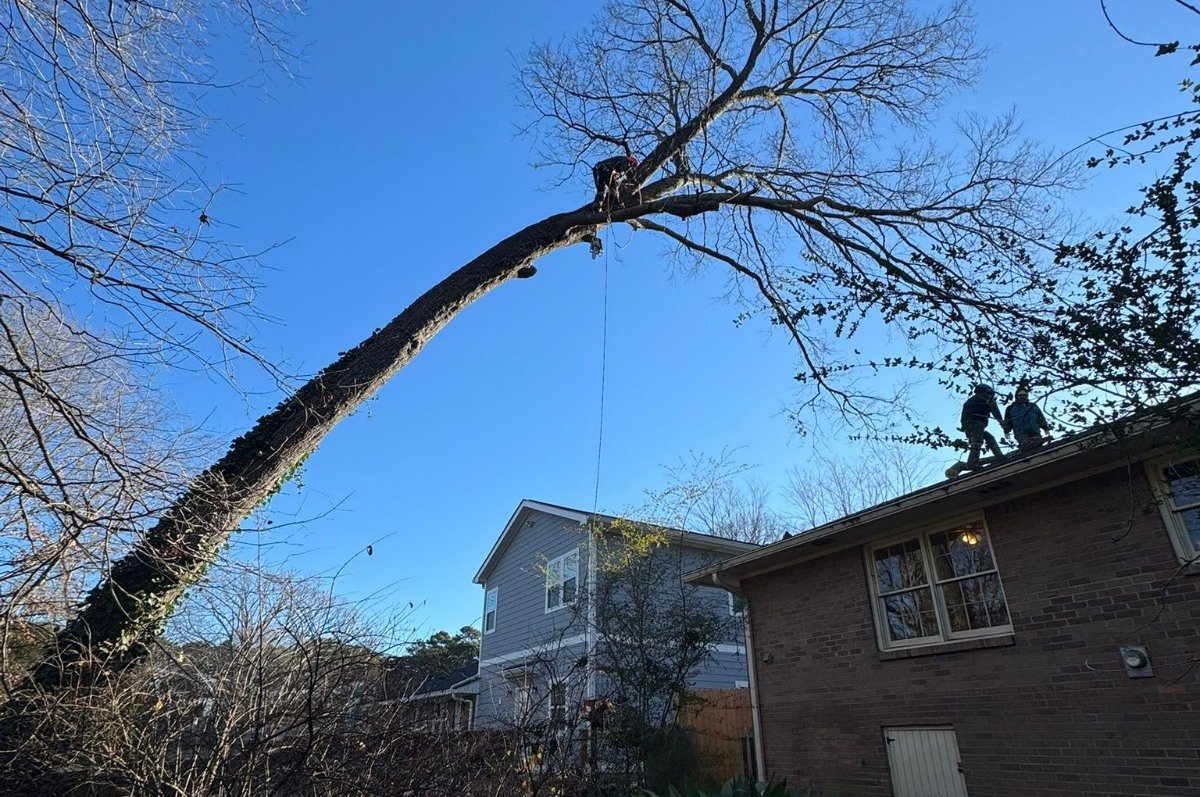
Why Leaning Trees Are Particularly Dangerous in Clarkston & Decatur
The established neighborhoods throughout Clarkston and Decatur feature mature tree canopies planted decades ago when these communities first developed. These older trees face unique challenges that create dangerous leans:
Mature Tree Vulnerabilities
Aging root systems in trees planted 40-60 years ago may have compromised structural integrity. Root decay, disease, and soil changes over decades weaken the foundation that keeps trees stable. A tree that stood straight for 50 years can develop sudden leans when root systems finally fail.
Throughout Historic Decatur’s tree-lined streets and Clarkston’s established neighborhoods, mature oaks, pines, and hardwoods show their age through developing leans that signal underlying root problems.
Construction impacts from decades of utility work, additions, renovations, and landscape changes have damaged root systems throughout both communities. Roots cut for sidewalk repairs 20 years ago may only now result in visible tree instability as decay progresses.
Soil conditions in DeKalb County’s red clay create particular challenges. Clay soils become rock-hard when dry and slippery when saturated, creating conditions where root systems lose their grip during wet periods after extended drought.
Weather Patterns Affecting DeKalb County
Georgia’s severe weather creates specific risks for trees in Clarkston and Decatur:
Frequent thunderstorms from March through September produce high winds that stress trees repeatedly. A tree that survives one storm with minor lean may fail completely during the next weather event.
Soil saturation during Georgia’s wet periods softens ground and reduces root anchorage. Trees that appear stable during dry weather can topple in saturated soil during heavy rain events.
Ice storms occasionally impact metro Atlanta, loading branches with heavy ice that increases leverage forces on already-leaning trunks. The combination of ice weight and compromised stability creates extreme failure risk.
Tornado activity in the region, while not as frequent as other parts of the South, has affected DeKalb County multiple times. Straight-line winds from severe thunderstorms create tornado-like damage without official tornado classification.
Urban Forest Stress Factors
Trees in Clarkston and Decatur face urban pressures that contribute to instability:
Competition for resources in densely planted areas creates stressed trees with compromised vigor. Weakened trees lean toward light and space, developing angles that eventually become structurally unsustainable.
Limited root space in developed areas with hardscaping, utilities, and buildings constrains root system development. Trees with restricted root zones cannot develop the structural support necessary to remain upright as they mature.
Air pollution and urban heat stress trees throughout metro Atlanta’s urban core. Stressed trees allocate resources to survival rather than structural development, creating situations where trunks and root systems cannot support the tree’s weight properly.
Understanding Tree Leans - Normal vs. Dangerous
Not all leaning trees require immediate removal, but understanding the difference between safe and dangerous leans can literally save lives and prevent devastating property damage.
Natural vs. Sudden Leans
Trees that grew leaning from their youth often develop compensating root systems and trunk wood that support the lean safely. You’ll see these throughout Decatur’s older neighborhoods—trees that have leaned the same direction for decades without problems.
These naturally leaning trees show:
- Consistent lean angle over many years
- Root flare visible on the compression side (downhill)
- No soil heaving or exposed roots
- Healthy canopy and vigorous growth
- No cracks or separations in trunk or root collar
Recently developed leans signal serious problems requiring immediate attention. If a tree that stood straight last year now leans noticeably, something has compromised its stability—and it’s likely to fail.
Recently leaning trees often show:
- Soil mounding or cracking on one side of the trunk
- Exposed roots previously underground
- Lean that increases after storms or heavy rain
- Cracks in trunk or at ground level
- Declining health or dying branches
Degree of Lean and Risk Assessment
The angle of lean significantly affects risk:
Slight leans (less than 10-15 degrees from vertical) may be manageable if the tree is otherwise healthy and shows no signs of progressive movement. However, professional assessment is essential even for apparently minor leans that developed suddenly.
Moderate leans (15-25 degrees) require immediate professional evaluation. Trees at this angle are approaching the point where self-correction becomes impossible and failure becomes increasingly likely.
Severe leans (over 25 degrees) represent extreme hazards requiring urgent action. Trees leaning this severely will almost certainly fail—the only question is when, not if.
Throughout Clarkston and Decatur, we’ve responded to emergencies involving trees at all lean angles. Even seemingly minor leans can progress to failure rapidly once root systems begin failing.
Direction of Lean Relative to Targets
Where a tree leans determines the urgency of response:
Leaning toward structures creates immediate emergency situations. A tree leaning toward your Clarkston or Decatur home threatens catastrophic damage when it falls. These situations demand same-day professional assessment and typically require immediate removal.
Leaning toward driveways or parking areas threatens vehicles and blocks access when trees fall. While less immediately life-threatening than trees over homes, these situations still require urgent attention.
Leaning toward neighbor properties creates liability concerns along with safety issues. Trees on your Clarkston or Decatur property that lean toward neighboring homes make you potentially liable for damage when they fall.
Leaning toward open areas present lower immediate risk but still require professional assessment. Even trees that would fall in yards rather than on structures can cause significant damage and become much more dangerous during storms.
Critical Warning Signs of Dangerous Leans in DeKalb County Trees
Recognizing warning signs allows homeowners to call for professional assessment before trees fail catastrophically:
Soil and Root Zone Changes
Soil heaving on the side opposite the lean indicates roots pulling up from the ground. Walk around the base of leaning trees looking for soil that appears lifted, cracked, or mounded. This visible root failure signals imminent tree failure.
In Decatur’s established neighborhoods and Clarkston’s mature residential areas, soil heaving often becomes visible after heavy rain when saturated soil allows progressive root failure.
Exposed roots that were previously underground show the tree is pulling up from the soil. Roots should be covered by soil—seeing them exposed indicates the root ball is lifting and failure is approaching.
Cracks in the soil radiating from the trunk indicate root movement and potential failure. These cracks, particularly visible in DeKalb County’s clay soils, show the root system is separating from surrounding soil.
Leaning root flare where the base of the trunk appears to be tilting reveals that roots are no longer anchoring the tree vertically. The root flare—the widened base where trunk meets ground—should be relatively level. Tilted root flares indicate the entire root system is moving.
Trunk Warning Signs
Cracks in the trunk particularly at ground level or where lean is most pronounced indicate structural failure in progress. Wood cracks suggest the tree is literally tearing itself apart under the stress of leaning.
Separation at root collar where trunk meets root system shows the attachment is failing. This critical junction point bears enormous stress when trees lean—visible separation means failure is imminent.
Wound or cavity exposure on the compression side (downhill side of lean) indicates decay weakening the trunk. Leaning increases stress on already weakened wood, accelerating failure.
Bark splitting along stress lines shows wood failure is occurring beneath the bark. Fresh splits that appeared after storms or during wet weather signal progressive structural failure.
Fungal Growth and Decay
Mushrooms or conks growing from trunk base indicate internal decay. Fungal fruiting bodies are visible evidence of rot inside the tree that severely compromises strength.
Soft or spongy bark at the trunk base that gives when pressed indicates decay. Healthy trees have firm, solid bark—soft areas reveal internal rot.
Sawdust or insect frass around the trunk base suggests boring insects attacking weakened wood. Borers typically attack stressed or declining trees, further weakening already compromised structures.
Canopy and Branch Indicators
Dying branches in an otherwise healthy tree indicate root damage affecting water and nutrient uptake. Leaning trees with declining canopies show that root damage is severe enough to affect tree health beyond just structural stability.
Lean increasing in canopy more than in trunk suggests the tree is bending as well as leaning at the roots. This compound failure mode is particularly dangerous.
One-sided canopy where growth concentrates away from the lean direction shows the tree attempting to compensate. While this demonstrates the tree recognizing its instability, it actually increases danger by adding weight on the side already under greatest stress.
Common Causes of Dangerous Leans in Clarkston & Decatur
Understanding why trees develop dangerous leans helps homeowners identify at-risk trees before leans become visible:
Storm Damage and Wind Events
DeKalb County’s frequent severe weather causes numerous leaning tree emergencies:
Straight-line winds during thunderstorms push against tree canopies with tremendous force. Trees with compromised root systems or decay may survive the immediate storm but develop leans that progress to failure over subsequent days or weeks.
Saturated soil conditions during and after heavy rain reduce root anchorage dramatically. Trees that appear stable in dry conditions can be pushed into dangerous leans during wet weather events.
Repeated storm stress over multiple weather events progressively weakens root systems. A tree that leans slightly after one storm may lean dramatically after the next, finally failing during a third storm.
Throughout Clarkston and Decatur, we respond to leaning tree emergencies primarily after severe weather events. The correlation between storms and dangerous leans is clear and consistent.
Root System Failures
Multiple factors compromise root systems, eventually causing visible leans:
Root decay and disease progresses slowly over years before becoming apparent through visible lean. Fungal pathogens attacking root systems can destroy structural roots while trees appear healthy above ground.
Construction damage from utility trenching, sidewalk installation, driveway work, or building additions severs roots that cannot regenerate. Trees may survive years after construction before root loss finally manifests as dangerous lean.
Soil compaction from vehicles, foot traffic, or construction destroys soil structure necessary for root function. Compacted soils suffocate roots, leading to slow decline and eventual structural failure visible as lean.
Grade changes that bury or expose roots alter moisture, oxygen, and temperature in root zones. Trees may adapt to modest grade changes but severe alterations often lead to root death and subsequent leaning.
Specific Clarkston and Decatur Considerations
Aging infrastructure improvements throughout both communities mean many trees have experienced root damage from utility work, street improvements, and sidewalk repairs over decades. Damage that occurred 10-20 years ago may only now result in visible instability.
Development pressure in Decatur and Clarkston means trees often stand near construction sites where soil compaction, grade changes, and direct root damage occur even on properties not being developed.
Species-Specific Vulnerabilities
Certain tree species common in Clarkston and Decatur are particularly prone to developing dangerous leans:
Bradford pears throughout both communities are notorious for weak wood and poor branch structure. These trees commonly develop leans as they age, with failure often occurring during storms.
Pines including loblolly and white pines develop shallow root systems that provide less stability than hardwoods. Pine leans often progress rapidly once started, requiring urgent intervention.
Poplars and willows grow rapidly but develop weak root systems relative to their size. These trees commonly lean and fail, particularly in wet soil conditions.
Declining oaks affected by disease, age, or stress may develop leans as root systems fail. While healthy oaks are generally stable, those showing decline require monitoring for developing instability.
Why Clarkston & Decatur Residents Trust Francisco's Trees 24/7
Our experience throughout DeKalb County positions us uniquely to serve these communities:
Local Knowledge and Experience
Years serving Clarkston and Decatur mean we understand local conditions, tree species, and common failure patterns in your specific neighborhoods.
Established relationships with local insurance adjusters, utility companies, and emergency services facilitate efficient response during crises.
Knowledge of area properties including lot sizes, tree populations, and construction patterns helps us respond quickly and effectively.
24/7 Emergency Response
Round-the-clock availability means Clarkston and Decatur residents can reach us anytime dangerous tree situations develop.
Rapid response times throughout DeKalb County ensure emergency situations receive prompt attention.
Storm response experience means we’re prepared for surge demands after severe weather affects multiple properties simultaneously.
Professional Expertise and Equipment
Certified arborists with ISA credentials provide expert assessments and recommendations.
Specialized equipment for hazardous removals ensures even dangerous leaning trees can be removed safely.
Comprehensive insurance protects your property and provides peace of mind during emergency operations.
Licensed and bonded status ensures professional standards and accountability.
Leaning trees in Clarkston and Decatur represent genuine emergencies that demand immediate professional attention. Don’t wait for trees to fall before acting—by then it’s too late to prevent the damage, injuries, and expenses that tree failures cause.
If you have a leaning tree on your property or are concerned about a neighbor’s leaning tree threatening your home, contact Francisco’s Trees 24/7 immediately. Our certified arborists serve Clarkston, Decatur, and all of DeKalb County with emergency assessment and removal services available around the clock.
We understand the stress and concern that dangerous leaning trees create, and we’re committed to responding rapidly to protect your property and your family. Don’t gamble with a leaning tree—call us today for professional assessment and prompt removal of dangerous trees before they cause the catastrophic damage we see too often in our emergency responses.
Available 24/7 for emergency leaning tree assessment and removal throughout Clarkston, Decatur, and all DeKalb County. Call now—the next storm could be the one that brings your leaning tree down.
Clarkston and Decatur present a specific combination of risk factors that make leaning trees in these communities significantly more dangerous than equivalent trees in newer suburban developments. The mature tree populations throughout Historic Decatur’s tree-lined streets and Clarkston’s established residential areas were planted 40–60 years ago — these trees are entering the phase of their lifespan where internal root decay, accumulated construction damage, and decades of urban soil stress converge simultaneously. Unlike trees in newer Gwinnett or North Fulton subdivisions where root systems are young and soil disturbance history is limited, trees in Clarkston and Decatur have endured generations of utility trenching, sidewalk repairs, driveway work, and building additions that have progressively damaged root systems over decades — damage that only now manifests as visible lean as the affected roots finally fail. DeKalb County’s red clay soil amplifies this risk: during Georgia’s frequent heavy rain events, clay soils transition from firm to near-liquid, stripping root anchorage from trees whose already-compromised root systems can no longer maintain stability in saturated conditions. The density of mature tree canopy in both communities also means a single failing tree frequently threatens adjacent structures, neighboring properties, and utility infrastructure simultaneously — a consequence of planting patterns from decades ago that didn’t anticipate how large these trees would eventually grow relative to property lot sizes.
This distinction is the single most important assessment our ISA-certified arborists make when evaluating leaning trees in Clarkston and Decatur, and understanding it correctly determines whether you’re dealing with a monitoring situation or an immediate emergency. A naturally leaning tree — one that developed its angle gradually from early growth — has had decades to build compensating structural adaptations. The root system develops stronger, denser growth on the tension side pulling against the lean, the trunk wood develops reaction wood internally that provides additional resistance along the lean axis, and the overall tree architecture has evolved around that specific angle. These trees throughout Decatur’s older neighborhoods can remain completely stable in their leaned position for decades when no underlying disease or damage is present. A recently developed lean — a tree that was visibly upright last season and now shows a noticeable angle — is a fundamentally different and far more dangerous situation. The root system was engineered to support a vertical tree, not a leaning one, meaning every remaining root connection is now under stress loads it was never designed to handle. Root failure, storm disturbance, soil saturation, or progressive decay has shifted the tree’s position, and the force required to hold it in that new position exceeds what the remaining root system can reliably provide. In Clarkston and Decatur’s DeKalb County climate, where saturated clay soils can shift conditions from stable to critical in a single rain event, a recently developed lean should always be treated as an urgent professional assessment situation — call Francisco’s Trees 24/7 at (678) 940-6503 within 24 hours, not at your next available weekend.
Clarkston and Decatur’s tree populations include several species that develop dangerous leans at higher rates than others, and knowing which trees on your property fall into these categories helps prioritize professional assessment. Bradford and Callery pears are among the most structurally compromised common landscape trees in both communities — their weak, narrow-angled branch attachments cause them to split apart in moderate winds as they age, and their root systems develop lean tendencies as the trees mature beyond their structural lifespan in Georgia’s climate. Loblolly and white pines throughout Clarkston and Decatur develop relatively shallow root systems that provide less lateral stability than deep-rooted hardwoods — once a pine develops any lean, progression tends to be faster than in hardwood species because the shallow roots lose anchorage in saturated clay more rapidly. Tulip poplars and sweetgums grow rapidly but develop root systems that can be disproportionately shallow relative to their height in DeKalb County’s compacted urban soils, creating stability vulnerabilities that manifest as lean during soil saturation events. Declining oaks affected by oak decline complex, construction root damage, or advanced age develop leans as their root systems progressively fail — particularly concerning because these can be very large trees with enormous destructive potential when they fall. Water oaks specifically are notorious throughout metro Atlanta for developing internal decay that is invisible externally while their structural core hollow out, with visible lean often appearing only in the later stages when removal becomes urgent. Call (678) 940-6503 if any of these species on your Clarkston or Decatur property have developed any new lean following recent storms or rain events.
The specific behavior of DeKalb County’s red clay soil during weather events creates a failure mechanism for leaning trees that is more abrupt and less predictable than in sandier or loamier soil types common in other Georgia regions. Clay soil has a property called thixotropy — it transitions from a semi-solid, structurally supportive state to a near-liquid state when fully saturated and subjected to mechanical disturbance, losing the vast majority of its shear strength in the process. For a leaning tree in Clarkston or Decatur, this means the soil that normally provides firm resistance against the direction of lean — gripping the root system and preventing further tipping — can transform into a medium with almost no resistance capacity during extended heavy rain. This transition can happen within hours of rainfall onset, meaning a tree that was safely anchored during morning hours can reach critical instability by afternoon during a sustained rain event. The situation is compounded by another clay behavior: shrink-swell cycles. During Georgia’s periodic droughts, clay soils in Clarkston and Decatur contract significantly, creating cracks and voids around root systems. When heavy rain arrives after a dry period, water rushes into these cracks and saturates the root zone extremely rapidly — faster than in soils that accept water more gradually. The result is that leaning trees in clay soil environments can fail more suddenly and with less warning than in other soil types. A tree showing any degree of new lean on DeKalb County clay should be professionally assessed before the next significant rain event — not after. Call Francisco’s Trees 24/7 at (678) 940-6503 for emergency assessment throughout Clarkston, Decatur, and all of DeKalb County.
Certain visible signs on a leaning tree in Clarkston or Decatur indicate that structural failure has progressed to the point where same-day professional response — not a scheduled appointment — is the only appropriate action. Soil lifting or mounding on the side opposite the lean is the most urgent single warning sign — visible ground heaving or cracking around the trunk base on the tension side means the root ball is actively pulling free from the soil and the tree can fall at any moment without any additional wind trigger. A lean angle that increased overnight or during the past rain event confirms active progressive failure rather than a stable historical lean — any tree showing measurable movement over hours or days is in the final stages before complete failure. The trunk moves detectably when moderate pressure is applied — any rocking or shifting in the root zone when you push against the trunk from a safe position indicates that root anchorage has failed to a critical degree. Fresh vertical cracks in the trunk at or near ground level mean the wood itself is tearing under the structural load of the lean — this is internal structural failure in progress. Roots that were underground yesterday are now visible — exposed roots that weren’t visible before a storm or rain event confirm the tree is actively uprooting. Mushrooms or shelf fungi at the base of a leaning tree combine two serious risk factors simultaneously — internal decay that has hollowed structural wood plus active lean creating stress on already weakened material. Any single one of these signs on a Clarkston or Decatur property warrants an immediate call to Francisco’s Trees 24/7 at (678) 940-6503 — do not wait for any of these signs to worsen before acting.
Georgia tree liability in neighbor-damage situations follows a negligence standard that makes the visibility and documentation of a tree’s hazardous condition the central legal question — and leaning trees are one of the clearest categories of visible hazard in tree law. If a tree on your Clarkston or Decatur property has developed a noticeable lean toward a neighbor’s home and your neighbor has documented that lean with photos, sent you written notification expressing concern, or had a professional assessment performed that identified it as a hazard, you have received actual notice of the hazardous condition. If that tree subsequently falls on your neighbor’s property, Georgia courts have consistently found liability for property owners who had actual notice of a hazard and failed to address it within a reasonable time. Even without formal notification from your neighbor, constructive notice — a lean visible enough that a reasonable property owner should have recognized the hazard — can establish liability in some circumstances. The practical implication for Clarkston and Decatur homeowners is straightforward: a leaning tree directed toward any neighboring structure is both a physical hazard and a financial liability exposure that increases with every storm that passes without professional assessment and action. Conversely, if your neighbor has a leaning tree directed at your property, written notification with dated photographs — sent via email or certified mail so delivery is documented — establishes their actual notice and significantly strengthens your legal position if their tree subsequently causes damage to your property. Francisco’s Trees 24/7 provides professional written hazard assessments by ISA-certified arborists that carry significant weight in insurance claims and legal proceedings — call (678) 940-6503 to schedule.
Yes — and this is one of the most important tree hazard mechanisms that Clarkston and Decatur homeowners need to understand, because it explains why trees in these established communities develop dangerous leans even without obvious recent storm events. Construction root damage is a slow-manifesting injury with a characteristic delay between the damage event and visible symptoms that can span 3 to 10 years depending on the extent of damage and the tree’s overall health. When utility trenching cuts through a significant portion of a tree’s root system — even 20 years ago — the affected roots cannot regenerate. The tree initially compensates through its remaining root system, but as the cut root zone continues to decay and the tree grows larger and heavier over subsequent years, the remaining roots must support an increasing structural load with diminishing capacity. The point where visible lean develops is often the point where this compensatory capacity is finally exceeded — which may be decades after the original damage. Throughout Clarkston and Decatur, where utility improvements, sidewalk replacements, and infrastructure upgrades have been conducted repeatedly across multiple generations, many trees are carrying accumulated root damage from multiple separate events over their lifespans. A tree that shows no lean today may be carrying root damage from a utility trench installed 15 years ago, a driveway widened 8 years ago, and a sewer line repaired 4 years ago — each event reducing the root system’s capacity incrementally until a final storm tips the cumulative damage into visible lean. Our ISA-certified arborists assess root zone history and soil conditions as part of comprehensive leaning tree evaluations in Clarkston and Decatur — call (678) 940-6503 for a professional assessment of any tree showing new lean on your property.
Yes — both Clarkston and Decatur are within our core 24/7 emergency response coverage throughout DeKalb County, and we respond to leaning tree emergencies at any hour without exception including nights, weekends, holidays, and during active storm periods. When you call (678) 940-6503, you reach a live member of our team directly — not an answering service, not a voicemail system, and not a dispatcher who will follow up in the morning. For active structural emergencies — soil lifting, visible root plate movement, a lean that increased during an ongoing storm — our crew is dispatched immediately and typically reaches Clarkston and Decatur properties within 45 minutes to 90 minutes depending on current conditions and call volume. For situations where the tree shows urgent warning signs but no imminent collapse, we schedule priority same-day assessment to evaluate the situation before the next weather event creates a critical failure condition. Our emergency response capability for Clarkston and Decatur is not theoretical — we have responded to leaning tree emergencies in these specific communities through every significant weather event that has affected DeKalb County since 2014, including severe thunderstorm outbreaks, tropical storm remnants, and winter ice events. The communities we serve most frequently for emergencies are exactly those we know best — and Clarkston and Decatur’s mature tree populations, clay soils, and dense residential development make emergency readiness especially important here. Save (678) 940-6503 in your phone now, before you need it. We also strongly encourage Clarkston and Decatur homeowners to call for a free pre-storm hazard assessment so identified leaning trees can be evaluated and addressed during safe weather conditions rather than during or immediately after the storm that triggers their failure.


